

Rob Faulkner, ACII · Chartered Insurance Broker
Reviewed 22 November 2026
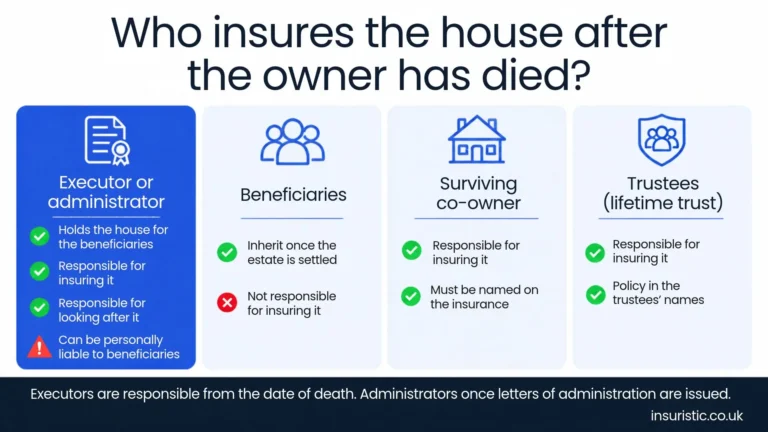
A common point of confusion is who is responsible for the house after someone dies and leaves it empty. It’s a fair question, but the answer isn’t always obvious, and I’ll explain why. I’m sorry for your loss, and I hope this helps.
Legally, someone who’s died can’t own property or hold an insurance policy because they’re no longer a legal entity, so what happens next depends on how the house was owned.
If the house was owned as joint tenants and one owner is still alive, the house passes straight to them. It doesn’t go through probate, and they’re responsible for insuring it. They just need to tell their insurer about the death and update the policy.
If there’s no surviving owner, the house belongs to the estate from the date of death until it’s either sold and the money passed to the beneficiaries, or inherited and the title transferred to the beneficiaries.
If the house was owned as tenants in common, I’ll explain that later.
Someone must be a custodian of the property in the meantime, and that can only be the executors if there’s a valid Will, or the administrators if there is no Will and the estate is deemed to be intestate. Up to four people can apply for the Grant in either situation.
If you’re one of the named executors in the Will, you’re responsible for the house from the date of the owner’s death, as are any other executors named in the Will. Don’t wait to act until you get the Grant of Probate. This is an area that catches a lot of people out; we often see property that hasn’t been continuously insured, even though probate has been in progress for weeks.
It’s quite common not to have a Will. According to the National Will Register 2026 report, approximately half of UK adults don’t have one.
If you have the Letters of Administration, you have the legal responsibility to insure the property straight away, and you can get a quote from Insuristic online in a couple of minutes.
If you don’t have the Letters of Administration yet, insuring the property can be difficult. Executors named in a Will have the legal authority from the date of the owner’s death, but without a Will, nobody has authority until the court issues the Letters of Administration.
If there isn’t a Will, and the Letters of Administration, or confirmation, as it’s called in Scotland, either haven’t been applied for, or you’re still waiting for them, then no one has legal authority over the property.
If you’re in England and Wales, you need to apply to the HM Courts and Tribunals Service through the official GOV.UK probate service.
Who administers the estate is set out in the Non-Contentious Probate Rules 1987, r.22.
To be considered for legal authority, each person must have a beneficial interest in the estate, and the rules decide in this order: spouse or civil partner, then children, then parents, then siblings, and so on.
If nobody qualifies, the estate passes to the Crown and the Government Legal Department’s Bona Vacantia division deals with it.
In rare cases, a creditor can also apply to become the administrator.
Most intestate estates are administered by a close family member or friend. The problem is, it can take up to 12 weeks for the court to appoint the administrators.
Until then, no one has the legal right to insure the property, which creates a real problem and may mean you struggle to get insurance online.
It’s not just about whose name goes on the policy. Without anyone legally in charge, the underwriter will be worried about who is actually looking after the house: keeping it maintained, doing the inspections, and sticking to the policy conditions. That’s why we ask about your relationship to the deceased, so the underwriter can see someone responsible is in charge.
Insurance quote journeys are unlikely to ask whether you have legal authority, so make sure you tell the insurer before you buy. Until the Letters of Administration arrive, nobody has the authority to insure, so you must seek underwriter approval.
Insuristic can usually help you arrange house insurance during probate in this situation, provided you are a relative of the deceased, and the underwriter approves the cover before you buy. Here is how you do it.
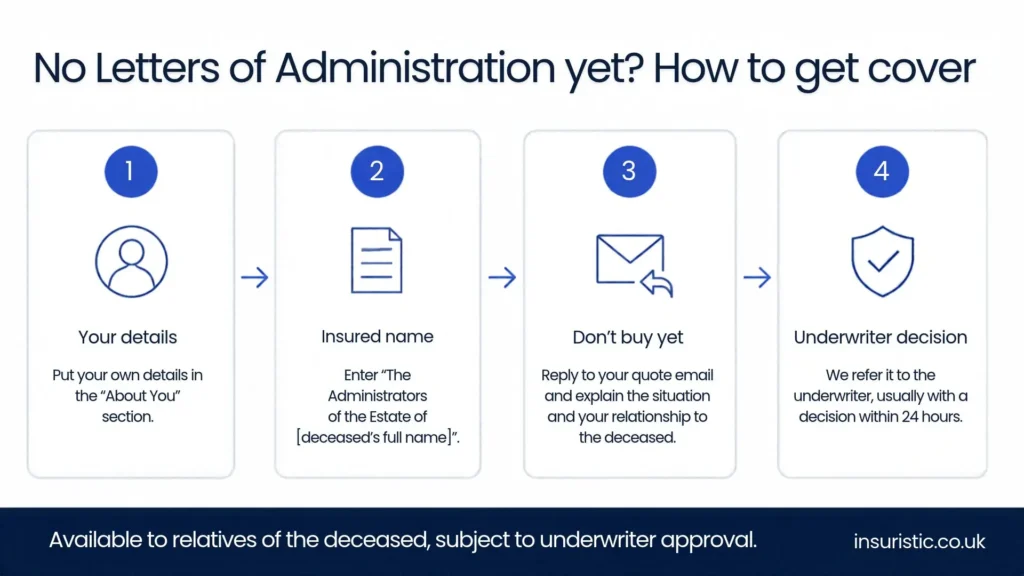
When requesting a quote, use your details in the “About You” section.
In the insured name, put “the administrators of the estate of” followed by the deceased’s full name. For example, “the administrators of the estate of John Smith.” You don’t need to name the administrators themselves, so the policy works for whoever the court appoints.
When you get your quote, do not buy the cover yet. Reply to your quote email and explain that you haven’t received the Letters of Administration yet and explain your relationship to the deceased.
We will then refer that to the underwriter, and they normally come back to us with a decision within 24 hours.
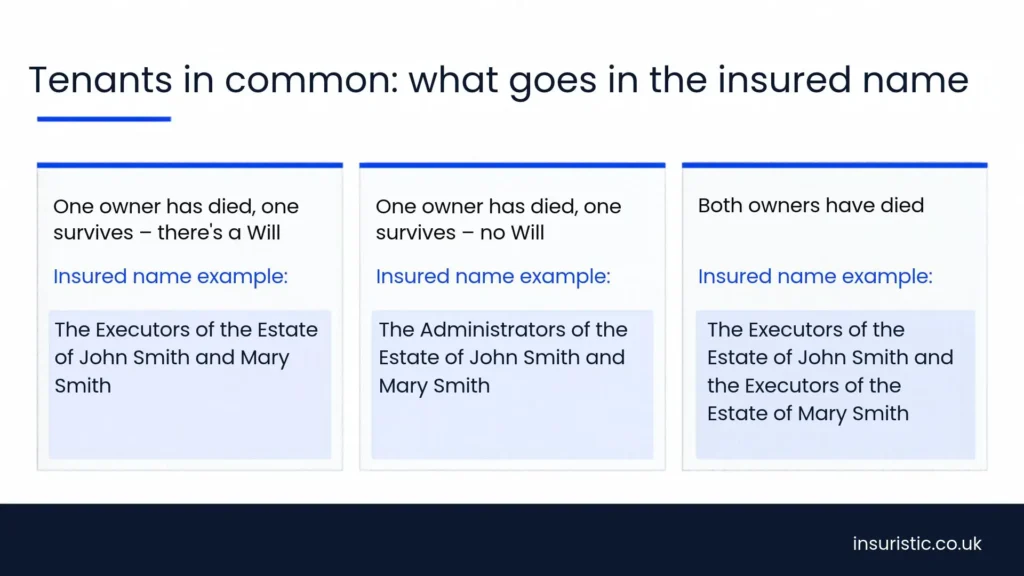
If the property was owned as tenants in common, then the ownership is shared between, usually, two people.
If one person dies, their share becomes part of the estate and must go through probate. If the other person is still alive, their share isn’t in probate. We see this a lot with empty houses, where one owner has died, and the other has gone into care. Both need to be properly recognised on the policy, or you can run into problems if there’s a claim.
And this is perfectly acceptable to insure with Insuristic. You just need to reflect it in the insured name.
For example, if there’s a Will, it would be the executors of the estate, then the deceased’s name, and then the surviving party’s name.
If there isn’t a Will, it’s very similar. You just swap the word “executors” with “administrators.”
If both partners have now sadly passed away, you just add the names of both estates in the insured name.
Sometimes a house might not be owned by the person who died at all. They might have put it into a lifetime trust. In that case, the house belongs to the trust, not to the estate, so it doesn’t need to go through probate.
The trustees are responsible for insuring it. They need to tell the insurer about the death straight away, and the policy should be in the name of the trustees of the trust, not the person who has died.
If the property is empty, you can insure it on our unoccupied home insurance policy.
When you reach the unoccupancy question on the first page, choose the reason that applies, such as pending sale, awaiting tenants or empty due to redecoration. Don’t choose death of the owner. This would trigger our probate journey, and as the house belongs to the trust, not the estate, it isn’t the right path.
Other types of trust usually still involve probate, and if you’re not sure whether that’s your situation, you should seek legal advice.
Almost all property insurance policies have a change-of-risk condition, which makes you responsible for telling the insurer about anything that might change their risk, often within 7 days. Some might allow longer, but you should check the policy.
A death is, unfortunately, a change in risk because it often means the property then becomes unoccupied or sometimes leaves people living in the property without an insurable interest.
If you fail to tell the insurer, this may invalidate your cover, so you must tell them as soon as possible.
I’ve written more about this in why it’s risky to extend the deceased’s home insurance.
If the property isn’t insured properly and something happens, such as a break-in, a burst pipe, or a fire, personal representatives can be held liable for that loss by the beneficiaries. It’s really important to sort the insurance out first. I appreciate that can be difficult, particularly when you’re grieving, but you must protect yourself from liability to the beneficiaries.
Insuristic specialises in probate and empty property. Our policy is designed specifically for probate and to protect you from liability to the beneficiaries. We make cover easy to understand and to buy online in a couple of minutes, and you can do this from our probate house insurance page.
Rob Faulkner founded Insuristic and has over 30 years' experience in the UK insurance market. He is an ACII Chartered Insurance Broker, a Chartered Manager, and a Member of the Chartered Institute of Marketing. He also served on the judging panel for The British Wills and Probate Awards 2026.
Rob writes regularly about the risks executors and administrators face during the probate process, and the insurance that protects them, from property to legal indemnity.
Want to learn more? Visit Rob's author page or follow Rob on LinkedIn.

Insuristic Limited is an Appointed Representative of SJL (Worcester) Ltd, who are authorised and regulated by the Financial Conduct Authority with the reference number 991835. This can be checked by visiting https://register.fca.org.uk/s/.
Registered Office: Unit 2, 262 Walsall Road, Cannock, England, WS11 0JL. Registered in England and Wales No: 13926650.
Insuristic is a registered trademark. ©Copyright 2026 Insuristic Limited. All Rights Reserved.