

Rob Faulkner, ACII · Chartered Insurance Broker
Reviewed 21 November 2026
If you’re responsible for a probate estate, one of the easiest things to get wrong is the property’s rebuild value when arranging insurance cover. It doesn’t matter if the figure came from the deceased’s old home insurance policy or you set it yourself. If the house is underinsured and something goes wrong, the insurer may pay out less than the repair or reinstatement cost, and the executor or administrator may have to fund the difference.
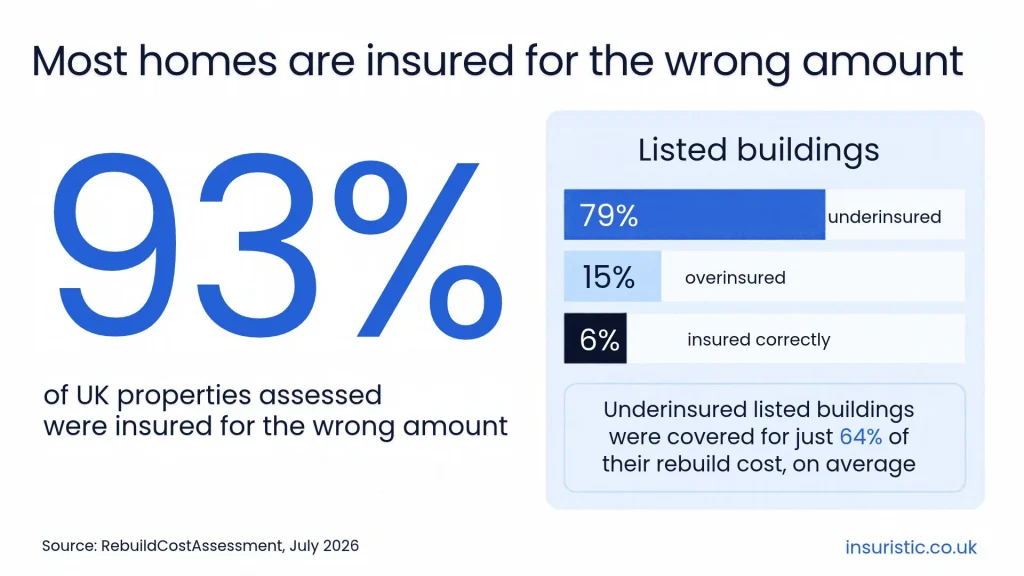
Unfortunately, this is a common problem. RebuildCostAssessment, whose whole business is built around carrying out rebuild assessments across the UK, found that 93% of UK properties they assessed were insured for the wrong amount. Listed buildings were no better. Only 6% were insured correctly, and the underinsured ones were covered for, on average, just 64% of what it would cost to rebuild them.
It is not surprising that many people get the rebuild cost wrong for a probate property. Appointing a RICS surveyor is the most reliable way to get an accurate rebuild cost.
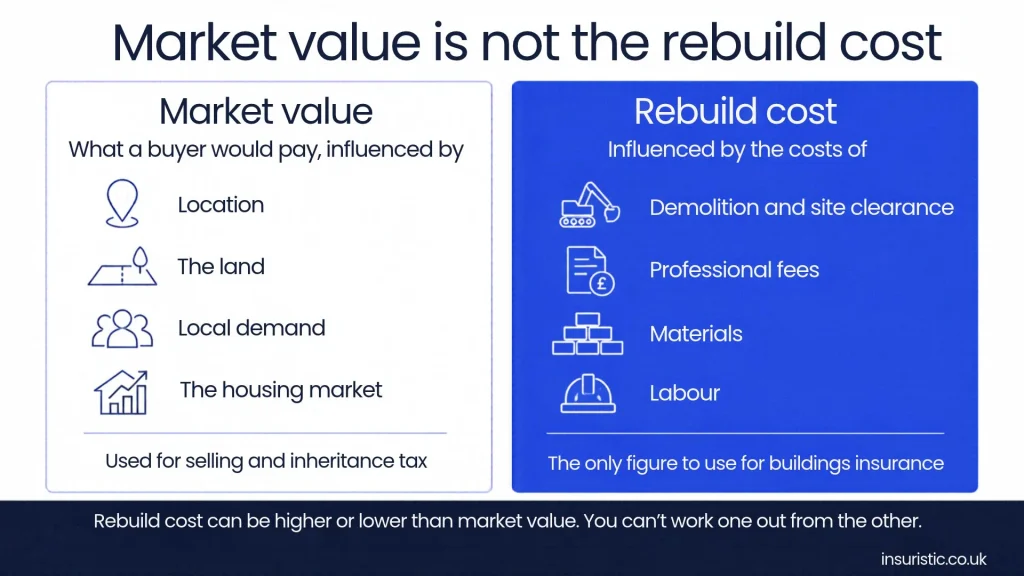
But if you’re researching this yourself, you’ll find a lot of mixed advice online about setting the rebuild cost. You might see statements that suggest the rebuild cost is less than the market value because it doesn’t include the land, which may not always be the case, so get an accurate rebuild value rather than relying on it.
In addition, when you’re reviewing the property, you might see several valuations, but you shouldn’t use them for insurance purposes. For example,
The only value you should consider for insurance is the rebuild cost. This is what it would cost to knock down the old house, clear the site, and rebuild it to the same standard. So that includes demolition, professional fees, materials, and labour. It’s nothing to do with what the property would sell for.
When you’re reviewing the existing insurance, you’re assuming that the previously declared figure is accurate. It might not be. If the deceased had inadvertently underinsured the property, you’re inheriting that risk by either continuing the cover or using it on a new policy.
The common scenarios which cause underinsurance are:
If the building rebuild cost is incorrect, you could be in for a shock when it comes to a claim.
The home insurer could refuse to pay the claim if a property is significantly underinsured, but more likely the result will be a reduction in the claim amount in proportion to the underinsurance.
Let me give you an example.
Imagine you insured the buildings for £200,000, but in the winter months you needed to make a claim for £25,000 to cover the damage caused by a burst pipe.
The insurer appoints a loss adjuster to survey the property damage.
In their report, they advise the insurer that the sum insured is less than the cost to rebuild the property to its original state. The loss adjuster calculated the rebuild cost to be £400,000.
As a result, the insurer reduces its claim settlement offer to £12,500, a 50% reduction to reflect the underinsurance.
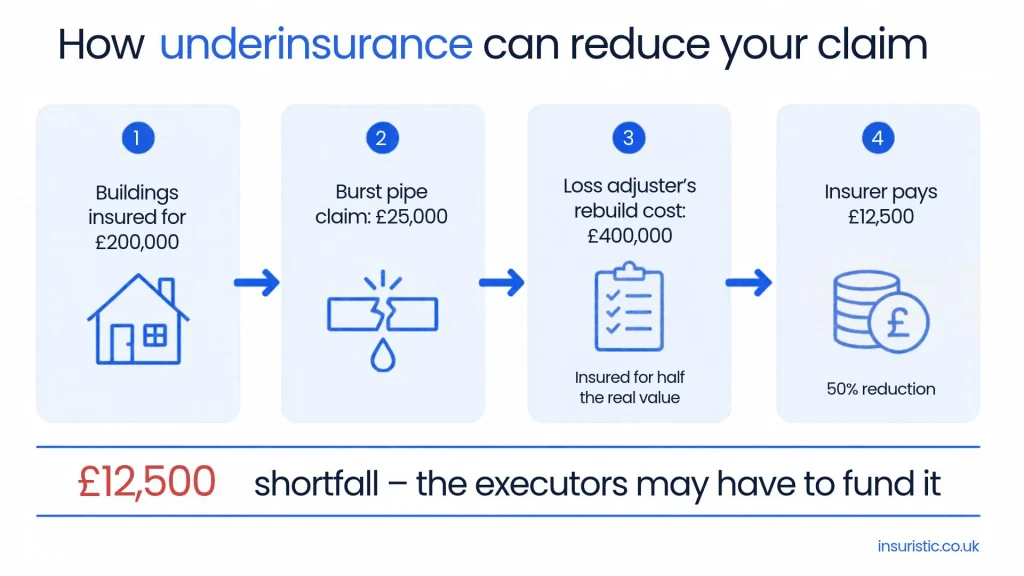
The beneficiaries may feel this is unfair for estate funds to be used to cover this amount of underinsurance. The beneficiaries may blame the personal representatives for not arranging adequate property cover and hold them liable to cover any shortfall in the claim.
Now imagine this is a fire that destroyed the property. The loss for the personal representatives could be £200,000, as this would be the maximum that the insurer would pay in this scenario.
The Financial Ombudsman website has plenty of examples of scenarios like this when policyholders have challenged an insurer’s decision, although they do not always win.
Complaints to the Financial Ombudsman Service are usually around the following areas:
This is challenging for most personal representatives because when the ombudsman looks at a complaint for underinsurance, it doesn’t just look at whether the house was underinsured.
The ombudsman will review whether your answer was reasonable, which means looking at the insurer’s question, whether it was clear, and what you used to base your figure on.
It accepts that there is no single right answer to a rebuild cost because even experts often disagree, so if your figure is reasonable and you took care in providing it, the ombudsman may rule that the claim is to be paid in full.
If your figure wasn’t reasonable, such as if you estimated it without any research evidence, the ombudsman would look at what the insurer would have done if it had known the right amount.
If it would have charged the same premium, they may recommend that the claim is paid in full. If the insurer would have charged more, which is usually the case for a declared rebuild value, the claim is usually reduced in line with the premiums you should have paid. So, if you’d paid £400 but should have paid £500, you’d get 80% of the claim.
If the insurer wouldn’t have covered the house at all (for example, it went over their maximum insured value), then they could reasonably turn the claim down completely.
Many insurance policies include what’s called an average clause, which is what I explained earlier, where an insurer can reduce your claim proportionately based on the amount of underinsurance. If you are underinsured, the insurer can use it to reduce your claim, and this could be more than in the previous example if the underinsurance is significant. If you think the result is unfair, then that’s when you can take it to the ombudsman for a review.
So if you’re acting as an executor or administrator, don’t make this figure up or take a best guess based on the market value – which is what many people do.
You should record where you got this figure from, such as if it’s from the ABI’s calculator, an old survey, or a rebuild cost assessment; keep this as your evidence of trying to provide a reasonable figure.
You can get an approximate rebuild cost valuation from the ABI’s rebuild cost calculator. This is only an approximate guide and is based on an average property of the same size and type.
If you have time, you could pay for a rebuild valuation. These can normally be done remotely for residential property and turned around in less than a week.
There are a couple of firms in the marketplace that can do this quite reasonably.
Firstly, you have Barrett Corp Harrington who can do both rebuild and red book valuations that you might need for probate.
Then you have rebuildcostassessment.com, who I’ve referenced already. They can also do remote rebuild assessments.
If all this sounds scary, which it should, there is a much easier way if you insure with Insuristic.
If the property has four bedrooms or fewer, you can get a quote based on the number of bedrooms, without needing to declare a rebuild value.
Insuristic could then provide a policy for a rebuild value of £750,000. If that is enough to rebuild the property, you have completely avoided the risk of underinsurance.
Doesn’t this sound a lot simpler than all of what I’ve just said?
You can arrange house insurance while in probate online with Insuristic in a couple of minutes without all this stress.
Rob Faulkner founded Insuristic and has over 30 years' experience in the UK insurance market. He is an ACII Chartered Insurance Broker, a Chartered Manager, and a Member of the Chartered Institute of Marketing. He also served on the judging panel for The British Wills and Probate Awards 2026.
Rob writes regularly about the risks executors and administrators face during the probate process, and the insurance that protects them, from property to legal indemnity.
Want to learn more? Visit Rob's author page or follow Rob on LinkedIn.

Insuristic Limited is an Appointed Representative of SJL (Worcester) Ltd, who are authorised and regulated by the Financial Conduct Authority with the reference number 991835. This can be checked by visiting https://register.fca.org.uk/s/.
Registered Office: Unit 2, 262 Walsall Road, Cannock, England, WS11 0JL. Registered in England and Wales No: 13926650.
Insuristic is a registered trademark. ©Copyright 2026 Insuristic Limited. All Rights Reserved.